
Sayyed Taha Hussain Madani
Head of the Smart Governance Think Tank
The Global Food War and the Fifth Column of Agricultural Land Use Change
The Role of the Seventh Development Plan in Ensuring Food Security
If comprehensive protection and preservation of agricultural lands are not considered in the Seventh Development Plan, we will soon face serious challenges in food security.
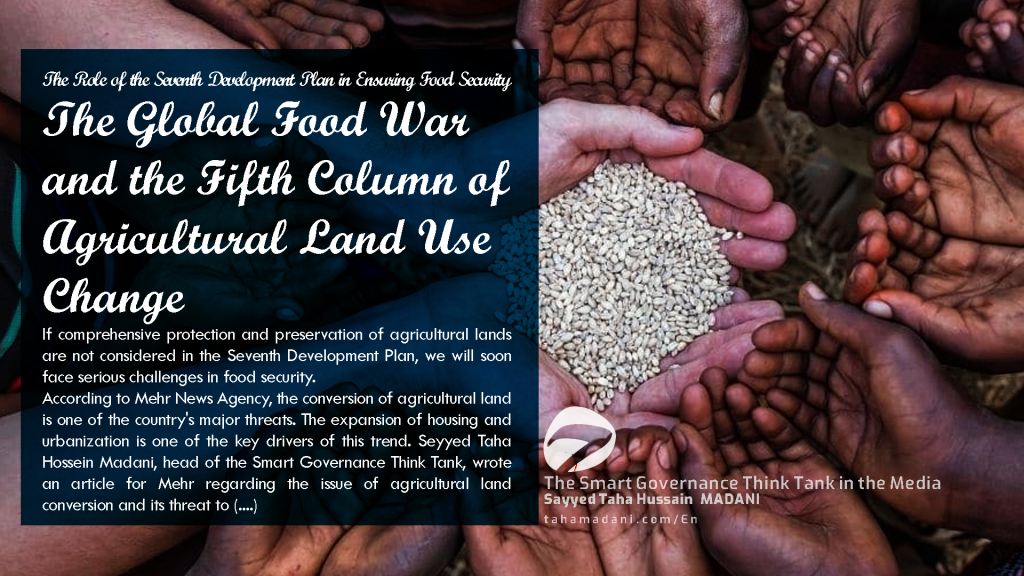
According to Mehr News Agency, the conversion of agricultural land is one of the country’s major threats. The expansion of housing and urbanization is one of the key drivers of this trend. Seyyed Taha Hossein Madani, head of the Smart Governance Think Tank, wrote an article for Mehr regarding the issue of agricultural land conversion and its threat to food security.
Currently, only 12 to 15 percent of the country’s land is suitable for cultivation and exploitation. If comprehensive protection of these lands is not incorporated into the Seventh Development Plan, not only will we face a serious food security challenge in the near future, but we will also become increasingly dependent on other countries for essential food supplies.
National independence has always been one of the main objectives of the Islamic Revolution, and achieving sustainable food security is a fundamental factor in ensuring this independence. Given the current global situation and the ongoing battle over food resources, the importance of food security has become more evident than ever. Over the years, the Supreme Leader of the Revolution has repeatedly emphasized the importance of sustainable food security. In 2019, he even instructed the Supreme Council of the Cultural Revolution to draft a Food Security Document.
Act One: Food Security as a Pillar of National Power
Food security means ensuring that all members of society have physical, fair, and economic access to sufficient, safe, and nutritious food. In today’s world, a nation’s sovereignty and independence are directly tied to its ability to maintain sustainable food security. However, the absence of clear and strategic goals in this area has created significant challenges for Iran.
This negligence reached a point where even high-ranking officials—including past presidents—did not fully believe in the necessity of achieving food self-sufficiency. Some officials even argued that reliance on food imports from other countries was justifiable and that self-sufficiency in agriculture was not a prerequisite for national independence.
A review of the latest FAO (Food and Agriculture Organization of the United Nations) statistics clearly demonstrates the direct link between food security and a nation’s economic and social resilience. According to FAO, 4.9% of the population in upper-middle-income countries faces severe food insecurity. In contrast, this figure rises to 29.3% in lower-middle-income nations. Additionally, food insecurity is worsening worldwide—severe food insecurity increased from 9.2% in 2018 to 11.7% in 2021.
Iran currently ranks 76th out of 195 countries in the Global Food Security Index, placing it above the global average. However, government officials acknowledge that the targets set in the Sixth Development Plan for food security were not fully achieved. The food security index in Iran was about 53% in 2013 and rose to 80% by the end of the Sixth Plan, while the target was 95%.
Act Two: Agricultural Land and the Future of Food Security
Achieving sustainable food security in Iran’s Seventh Development Plan depends on maximizing the potential of the agricultural sector. However, this requires smart planning that aligns with regional land-use planning and climatic limitations. Unfortunately, Iran’s agricultural sector faces multiple obstacles, including a lack of incentives and support policies, inefficient farming practices, and land degradation.
As a result, farmers are increasingly reluctant to continue working in agriculture, leading to a steady decline in farmland productivity and the fragmentation of fertile agricultural lands.
According to official reports, over 18 provinces in Iran are now experiencing drought conditions, and 55% of the country’s land area is classified as arid or semi-arid. In addition, Iran’s agricultural output per hectare is significantly lower than that of leading agricultural countries. Factors such as water scarcity, soil depletion, and reliance on traditional farming methods have further exacerbated food security challenges.
Currently, only 12 to 15 percent of Iran’s agricultural land remains cultivable. Without proper safeguards in the Seventh Development Plan, not only will food security be at serious risk, but the country will also become increasingly dependent on foreign food imports.
Act Three: The Decline of Agriculture as a Profession
The lack of development-oriented support for agriculture in past governments has caused farmers to lose interest in continuing their work. This has led to the steady fragmentation of agricultural lands, one of the most pressing threats to Iran’s food security.
In Iran, agriculture is not widely recognized as a profession with adequate benefits and support. The lack of incentives, declining land productivity, and continuous farmland fragmentation have resulted in a dangerous trend—the conversion of fertile agricultural lands to non-agricultural uses.
To reverse this trend, the Seventh Development Plan must include strong incentives for land consolidation and agricultural investment, as well as government-backed services and financial assistance to promote modern farming.
Final Act: A Strategic, Multi-Dimensional Approach
Ensuring sustainable food security is a complex, multi-faceted issue. If it is not managed through comprehensive strategic policies and long-term national planning, it will become increasingly unattainable. A national food security strategy must involve various institutions—both directly and indirectly— to ensure coordinated policymaking.
The Seventh Development Plan must prioritize food security as a national security issue. Without a structured, high-level policy framework, institutional conflicts and inconsistent policies will hinder progress. It is evident that sustainable food security can only be achieved through sustainable agricultural development. This, in turn, requires the consolidation and protection of agricultural lands to prevent their uncontrolled conversion into non-agricultural uses.
Your Comment