
Sayyed Taha Hussain Madani
Head of the Smart Governance Think Tank
The Relationship Between Freight Transport and Air Pollution
Although fuel oil is an extremely polluting and harmful fuel, fuel oil combustion is not the main culprit behind the country’s air pollution. The primary cause of pollution must be sought in the transportation sector. This fact can be understood by referring to the statistics from the country’s energy balance sheet. This balance sheet breaks down and reports the share of fuel oil and diesel in pollution: fuel oil accounts for 1.9% of particulate emissions and air pollution, while diesel accounts for 76%.
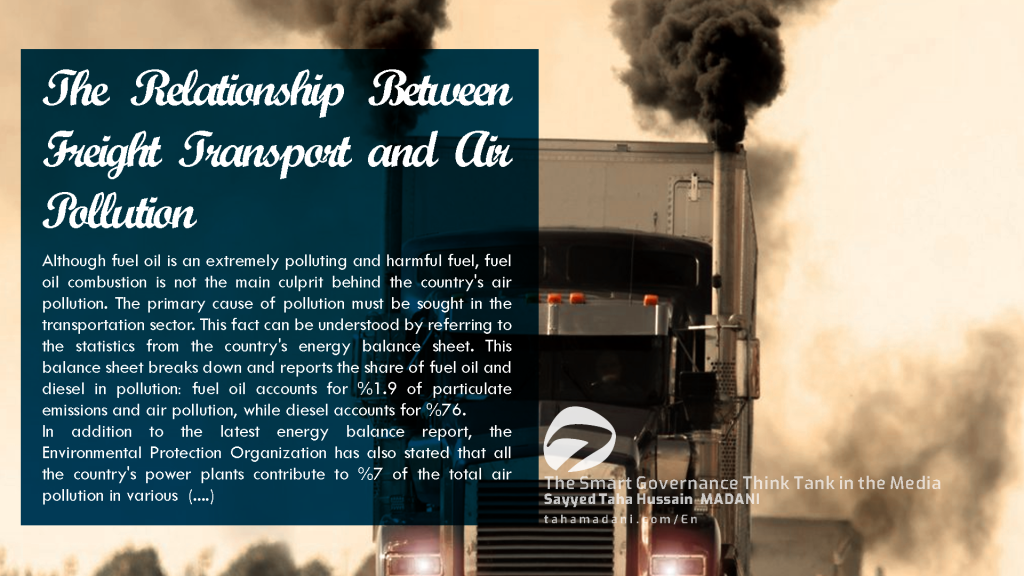
In addition to the latest energy balance report, the Environmental Protection Organization has also stated that all the country’s power plants contribute to 7% of the total air pollution in various regions. In contrast, light and heavy vehicles, or mobile sources, account for 80% of pollution. Considering that diesel is the primary fuel for public transportation, especially freight transport, and taking into account a portion of the total pollutant sources for public transportation, it can be estimated that public transportation’s share in air pollution is approximately 40 to 50%. Meanwhile, fuel oil combustion’s contribution to pollution does not even reach 2%. Therefore, if we aim to address the issue of air pollution in the country, we must adjust our approach according to each sector’s share and prioritize addressing the pollution caused by public transportation over fuel oil combustion.
Of course, the significant impact of fuel oil combustion on air quality in a specific area cannot be denied. This is evident when comparing the amount of carbon dioxide emitted from a fuel oil power plant to that of gas-fired or combined-cycle power plants. According to chemical compositions and combustion reactions, burning one cubic meter of natural gas releases approximately 2.75 kg of carbon dioxide, while burning just one liter of oil produces and releases 2.5 kg of carbon. Therefore, in a combined-cycle power plant using natural gas with 55% efficiency, producing one megawatt-hour of electricity requires 6,545 megajoules of energy. To generate this amount of energy, about 187 cubic meters of natural gas must be consumed, which, after combustion, produces approximately 513 kg of carbon dioxide. However, in a fuel oil power plant, this figure is between 800 and 1,000 kg—nearly double that of natural gas. Additionally, the amount of sulfur released from burning fuel oil is significantly higher than other fuels. Based on this analysis, the high pollution and damage caused by fuel oil in a specific area can be acknowledged and criticized. However, the country’s overall pollution cannot be attributed to fuel oil combustion. In other words, no one denies the harm caused by burning fuel oil, especially near residential areas, and its use in power generation and industries must undoubtedly be eliminated. Nevertheless, the crucial point is that we must accept that transportation’s share in pollution is incomparable to fuel oil and is significantly higher. Until this issue is acknowledged, demands for reducing air pollution will remain trapped in a vicious cycle.
The Unequal Competition Between Rail and Road
Public transportation is a vital sector of the country’s economy and cannot be shut down. Unfortunately, due to the severe aging of the fleet and the failure of modernization programs in recent years, this sector has become a major source of pollution. Recently, the Article 90 Commission also announced that 45% of this fleet is outdated. The disproportionately high share of road transport in the country’s freight transport, despite its economic and environmental damages, has led to misguided policies favoring road transport, further entrenching its position in the economy. Among these policies are the provision of cheap fuel and the flow of explicit and implicit subsidies to road transport, despite legal emphasis in upstream documents on rail transport. The higher share of roads in development budgets also confirms the support of executive managers for road transport, reducing the competitiveness of rail transport. These factors, along with the prioritization of road transport by the country’s executives, have resulted in 92% of the country’s freight, approximately 450 million tons, being transported by road, according to the Road Maintenance and Transportation Organization. In contrast, the total freight transported by rail is less than 50 million tons.
The Conventional Share of Rail in Freight Transport
This imbalance in the country’s freight transport sector exists while developed countries have long decided to shift their freight transport to rail. For example, the United States dedicates 80% of its 250,000 kilometers of railways to freight transport, and China transports 3 billion tons of freight annually by rail. The environmental advantages of rail transport over road transport and how developing rail transport can reduce air pollution are highly significant. To understand this advantage, the statistics from the Road Maintenance and Transportation Organization and the Railway Company can be compared. Comparing the diesel consumption of a train to transport one ton of freight over one kilometer with that of a truck shows that a train consumes 3.5 cc of fuel, while a truck consumes 33.3 cc. This means that road transport’s fuel consumption and, consequently, pollution are 9.5 times higher than rail transport. Additionally, burning 1,000 liters of diesel releases 2.6 kg of carbon dioxide. Based on these statistics and figures, I believe that instead of prioritizing fuel oil combustion in addressing pollution, we must consider transportation and the need to shift from road to rail. If the country moves in this direction, we can achieve clean and green transportation and implement better and newer environmental policies to reduce pollution.
The Need to Eliminate State Monopoly in Railways
It is necessary to change the policies favoring road transport in accordance with existing laws and shift towards rail transport. Additionally, the governance structure of the railways must be reformed, and interaction between the government, railways, and the private sector must increase. Incomplete privatization, destructive interventions, and state monopoly in the railway sector must be avoided. However, the lack of interest from traders, producers, and freight owners in rail transport due to its extremely low speed is concerning. It is regrettable that the speed of rail freight transport from origin to destination is only three kilometers per hour. With such a speed, how can we expect economic actors to trust rail transport? On the other hand, there is currently no system for registering freight requests with a specified tariff and procedure in the country, and freight owners sometimes have to make in-person visits to submit their requests. Even when they do, they face a convoluted process without a fixed and clear procedure. Many of these issues can be resolved by drafting a comprehensive transportation document, which has not yet been finalized.
If this document had been prepared in previous years, we would not be witnessing this unbalanced development in transportation infrastructure and the implementation of unjustified projects and longitudinal railway development instead of transversal development to address bottlenecks. The comprehensive transportation document must be finalized with a serious decision and expert consensus to move beyond this state of passivity. If the current situation continues, resource wastage in this sector will persist.
Of course, emphasizing the need for electrifying the country’s transportation to reduce air pollution is important. This issue primarily requires addressing the 24,000-megawatt electricity imbalance in the country. In this regard, the government has decided to produce 30,000 megawatts of electricity using solar energy within the next 3.5 years. Simultaneously, there is a discussion about increasing nuclear power production capacity.
Apart from addressing the imbalance, which must be done with a logical and rational approach, considering all methods of electricity production—fossil, solar, wind, nuclear, microreactors, etc.—according to each region’s potential and drafting a comprehensive and macro document, we need to change the country’s transportation model from road to rail and optimize transportation, especially through electrification. Based on this, we believe that the Ministry of Energy, in addition to efforts to address the imbalance, must also meet the future requirements arising from these reform policies and electrification to ensure that the necessary energy is available simultaneously or even before these policies are implemented. This forward-looking approach can reduce pollution and, through its side effects, improve the transportation environment in various sectors, especially transit.
Sayyed Taha Hussain Madani | Head of the Smart Governance Think Tank
Your Comment